Pilonidal sinus: the 15 most frequently asked questions, answered
Short answer: A pilonidal sinus (pilonidal disease) is a tract disease that does not go away on its own; it forms when hairs penetrate the skin over the tailbone. In people who have not had previous surgery and have limited disease, methods performed under local anaesthesia, such as laser or phenol, can be tried as a first option; in recurrent or extensive disease, surgery comes to the fore. In published studies, recurrence after laser has been reported at an average of around 4% at 1 year and around 15% at follow-up beyond 5 years; after flap operations at 2–5% at 5 years, and after midline closure at around 17%.
In this article we answer the 15 questions patients most often ask on Google and AI assistants, based on current scientific sources.
Questions in this article
- What is a pilonidal sinus and what causes it?
- What are the symptoms of a pilonidal sinus and how is it recognised?
- Does a pilonidal sinus go away on its own?
- Can a pilonidal sinus be treated without surgery?
- How is laser treatment for a pilonidal sinus performed?
- Which is more effective for a pilonidal sinus: laser or surgery?
- When can I return to social life after laser treatment for a pilonidal sinus?
- Is the return to work and social life quicker after laser treatment or after conventional surgery?
- What is the recurrence rate after laser treatment for a pilonidal sinus?
- What is the recurrence rate after crystallised phenol treatment for a pilonidal sinus?
- What is the recurrence rate after pilonidal sinus surgery?
- Can laser treatment for a pilonidal sinus be done under local anaesthesia, and is it painful?
- How much does laser treatment for a pilonidal sinus cost?
- Where can I have laser treatment for a pilonidal sinus in Istanbul?
- Where can I have laser treatment for a pilonidal sinus in Ataşehir, Istanbul?
Understanding the condition
1. What is a pilonidal sinus and what causes it?
A pilonidal sinus (pilonidal disease) is a tract, with associated inflammation, that forms when shed hairs penetrate the skin in the tailbone area.
Hairs that collect in the cleft between the buttocks with sitting and movement become embedded in the skin; the body treats them as foreign bodies, and over time tracts form under the skin. Dense body hair, a deep natal cleft, long periods of sitting at work, excess weight, heavy sweating and a family history of pilonidal sinus increase the risk. It is most common between the ages of 15 and 30 and in men.
2. What are the symptoms of a pilonidal sinus and how is it recognised?
The most typical finding is one or more small holes (sinus openings) in the midline over the tailbone, with pain, swelling or discharge in this area.
- Pain and tenderness that get worse when sitting
- Bloody, pus-like or foul-smelling discharge
- Redness and swelling; fever and throbbing pain when an abscess develops
- Sometimes just small holes that cause no symptoms
The diagnosis is usually made by examination; most patients do not need additional imaging. When discharge is close to the anus, other conditions such as an anal fistula are also investigated.
3. Does a pilonidal sinus go away on its own?
Usually not. The tract under the skin and the hairs inside it do not disappear on their own; antibiotics or drainage of an abscess can only reduce symptoms temporarily.
As long as the tract remains, the chance of it becoming inflamed again persists. In people who have no symptoms at all and only a small hole, monitoring under medical supervision and keeping the area free of hair can be discussed as an option. An abscess bursting on its own does not mean it has been treated; if there is a painful, swollen abscess, abscess drainage is needed first.
Treatment options
4. Can a pilonidal sinus be treated without surgery?
In suitable patients, yes. The so-called “non-surgical” methods are procedures such as laser and crystallised phenol that do not require a large incision and are performed under local anaesthesia.
These methods can be tried as a first option, particularly in patients who have not had previous surgery, do not have a very extensive tract and do not have an active abscess. In patients with recurrent disease, numerous and widespread sinus openings, or who have not healed with these methods before, surgery comes to the fore. Which method is suitable is decided at the examination.
5. How is laser treatment for a pilonidal sinus performed?
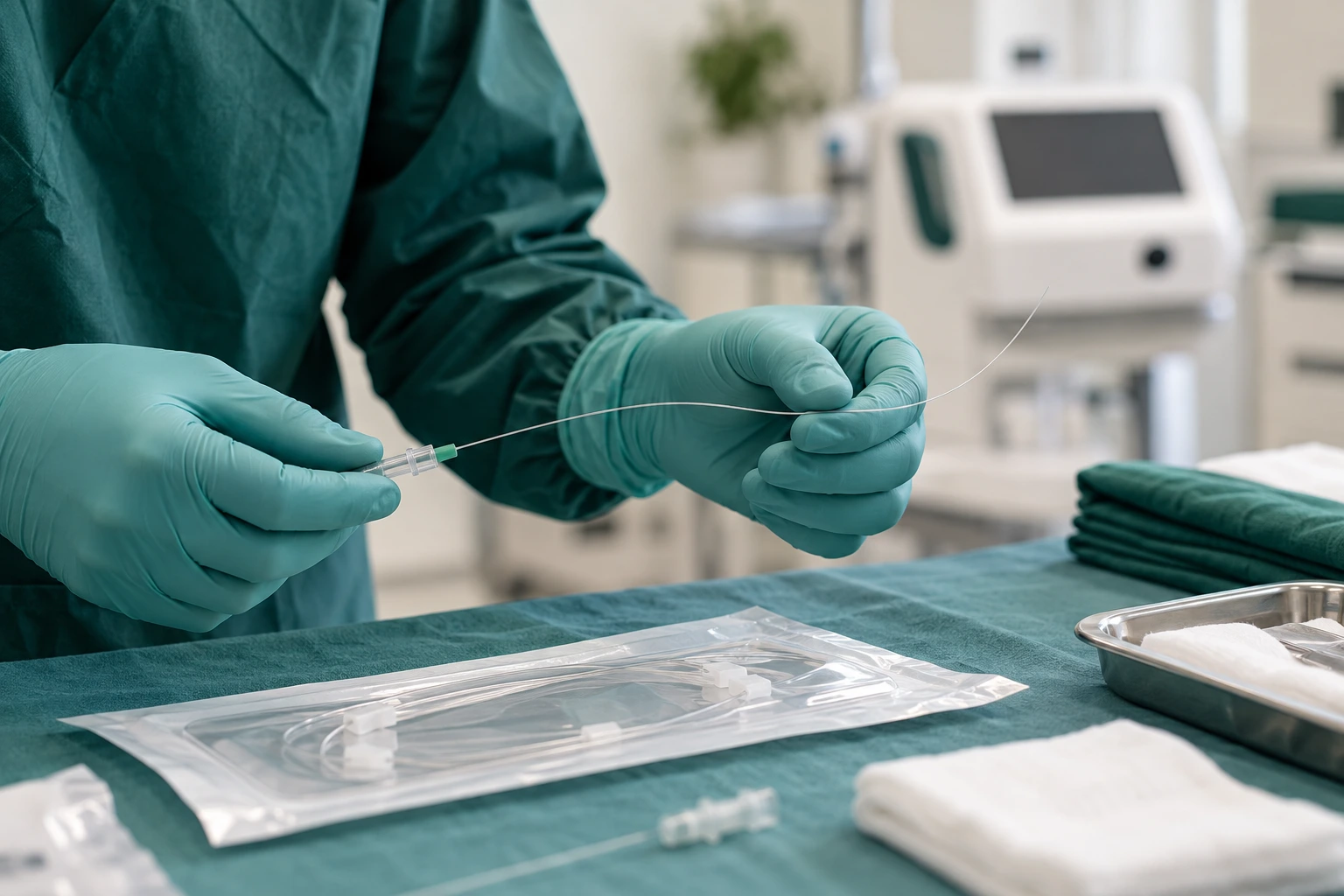
Under local anaesthesia the tract is cleaned, then a thin laser fibre is placed in the tract to close it from the inside. The procedure usually takes 30–60 minutes and you go home the same day.
- The area is numbed (local anaesthesia).
- Hairs and inflamed tissue inside the tract are cleared out through the sinus openings.
- A radial-tip laser fibre is placed in the tract and, as it is withdrawn, the tract wall is shrunk by heat and closed.
- A small dressing is applied; check-ups are planned in the first week and the following weeks.
Laser treatment for a pilonidal sinus is not the same procedure as laser hair removal. For details, see our laser pilonidal sinus treatment page.
6. Which is more effective for a pilonidal sinus: laser or surgery?
There is no single right answer for everyone; the choice depends on the extent of the disease and previous treatments.
In large reviews, operations using flap techniques (Karydakis/Bascom, Limberg) have among the lowest long-term recurrence rates of all methods; however, recovery and return to work take longer. Laser, on the other hand, offers good short- and medium-term results and less time off work in selected patients; long-term data are more limited than for surgery.
In practice: in people being treated for the first time with limited disease, laser or phenol can be tried as a first option; in recurrent or very extensive disease, surgery comes to the fore. For a comparison, see our article how to choose between laser, phenol and surgery.
Recovery and return to work
7. When can I return to social life after laser treatment for a pilonidal sinus?
Most people go home on the day of the procedure and usually resume daily life the same day or the next day; people with desk jobs mostly return to work within a few days.
Complete closure of the tracts from the inside can take a few weeks; a small amount of discharge during this period is normal. Avoiding long periods of uninterrupted sitting and keeping the area clean and dry are recommended. Activities that put pressure on the area, such as running, weight training and cycling, are usually resumed after a few weeks, according to the advice given at the check-up. For details, see our article on the recovery process.
8. Is the return to work and social life quicker after laser treatment or after conventional surgery?
With methods that do not require an incision, such as laser and phenol, return to work is usually within a few days; after conventional surgery this period is usually measured in weeks.
A review of phenol treatments reported an average return to work of 2–3 days. After conventional surgery the time depends on the technique used: for wounds closed with stitches (flap or midline closure) it is usually a few weeks, while for wounds left open to heal, closure of the wound can take weeks to months. The longer recovery time does not change the fact that surgery may be more suitable in selected patients.
Recurrence rates
9. What is the recurrence rate after laser treatment for a pilonidal sinus?
In scientific studies, recurrence after laser has been reported at an average of around 4% at roughly 1 year of follow-up and around 15% at follow-up beyond 5 years.
- In a systematic review covering 10 studies and 971 patients (median follow-up 12 months), healing after the first treatment was 94.4% and average recurrence 3.8%.
- In a series of 83 patients followed for a median of 5.2 years, recurrence was reported at 14.5%.
- In people who had previous surgery and whose disease had recurred, the healing rate after laser was 81.9% in a meta-analysis.
Reported rates rise as follow-up gets longer; the number of tracts, previous operations and hair control affect the outcome. These rates come from published studies and are not a promise of individual results.
10. What is the recurrence rate after crystallised phenol treatment for a pilonidal sinus?
A review of phenol studies found a success rate of around 87% at an average follow-up of 2 years; in other words, about 13% of patients did not heal or had a recurrence.
The same review reported better results in patients with 1–3 sinus openings. Some patients may need a second or third phenol application; long-term results vary considerably from study to study. Phenol can be used on its own or together with laser. For details, see our phenol treatment page.
11. What is the recurrence rate after pilonidal sinus surgery?
The recurrence rate after surgery varies greatly depending on the technique used: at 5-year follow-up it has been reported at around 17% for midline closure and around 2–5% for flap techniques.
In a comprehensive analysis pooling data from 89,583 patients, the 5-year recurrence rates were as follows:
| Surgical technique | Recurrence at 5 years | Recurrence at 10 years |
|---|---|---|
| Primary midline closure | 16.8% | 32.0% |
| Leaving the wound open | 13.1% | 19.9% |
| Limberg / Dufourmentel flap | 5.2% | 11.4% |
| Karydakis / Bascom flap | 1.9% | 2.7% |
The values in the table come mainly from non-randomised studies; in randomised studies, the rates for some techniques were higher. The high long-term recurrence risk of midline closure is one of the main reasons flap techniques are preferred.
Pain, cost and treatment in Istanbul
12. Can laser treatment for a pilonidal sinus be done under local anaesthesia, and is it painful?
Yes, the procedure is done under local anaesthesia. A brief burning sensation is felt during the numbing injection; during the procedure there is usually only a feeling of pressure or warmth.
Most patients do not need a general anaesthetic. There may be mild to moderate tenderness in the days after the procedure, which is usually controlled with simple painkillers. In very extensive disease, different anaesthetic options can be discussed depending on the extent of the procedure.
13. How much does laser treatment for a pilonidal sinus cost?
The fee for laser pilonidal sinus treatment is set individually, depending on the extent of the disease, the number of tracts, whether combination with phenol or a second session is needed, and the setting in which the procedure is performed.
In Istanbul, prices vary over a wide range depending on the healthcare facility and the extent of the procedure. We do not publish fixed prices on our website; current fee information is given after the examination. Coverage by SGK (the Turkish Social Security Institution) or private insurance varies by facility and policy. For preliminary information, you can call or WhatsApp +90 506 520 30 55.
14. Where can I have laser treatment for a pilonidal sinus in Istanbul?
It is advisable to have laser pilonidal sinus treatment with a general surgeon who performs both the examination and the procedure and who can also consider phenol and surgical options when needed.
When deciding, these questions can guide you: Who performs the procedure and who follows up the check-ups? Are methods other than laser also considered? What is the plan if there is an abscess? What happens in case of recurrence?
At his practice in Ataşehir, Istanbul, Op. Dr. Salim Balin performs laser pilonidal sinus treatment and phenol treatment for patients considered suitable after examination; where surgery is more appropriate, this option is also discussed. The practice is easy to reach from Asian-side districts such as Kadıköy, Üsküdar, Ümraniye, Maltepe and Çekmeköy.
15. Where can I have laser treatment for a pilonidal sinus in Ataşehir, Istanbul?
Op. Dr. Salim Balin's practice is at Atatürk Mahallesi, Ertuğrul Gazi Cad. No: 2H, Metropol İstanbul B Block, Floor 18, No 282, Ataşehir, Istanbul.
Laser pilonidal sinus treatment and phenol treatment are performed at this practice for suitable patients after examination. For appointments call or WhatsApp +90 506 520 30 55; the practice is open Monday–Saturday 09:00–18:00. Address and directions
Related guides
Laser pilonidal sinus treatment – Ataşehir ↗
Phenol treatment for pilonidal sinus ↗
Pilonidal sinus: how to choose between laser, phenol and surgery ↗
Sources and further reading
Romic I. et al. Laser treatment of pilonidal disease: a systematic review. Lasers Med Sci, 2022 ↗Koskinen K. et al. Long-term follow-up of pilonidal sinus disease treated by radial laser surgery. Langenbecks Arch Surg, 2024 ↗Qin J. et al. Efficacy and safety of laser ablation for recurrent pilonidal sinus: a systematic review and meta-analysis. Int J Colorectal Dis, 2025 ↗Kayaalp C, Aydın C. Review of phenol treatment in sacrococcygeal pilonidal disease. Tech Coloproctol, 2009 ↗Stauffer VK. et al. Common surgical procedures in pilonidal sinus disease: a meta-analysis, merged data analysis, and comprehensive study on recurrence. Sci Rep, 2018 ↗NHS · Pilonidal sinus ↗Updated: 21 October 2026 · Recurrence and success rates come from published studies; they are not a promise of individual results. General patient information; individual treatment is planned in consultation.
Ask me
Get in touch with your questions about Pilonidal sinus or to request an appointment.
💬 Ask me on WhatsApp — +90 506 520 30 55
✉️ Ask me by email — info@drsalimbalin.com
📍 We are at Metropol İstanbul Mall, in the best location in Ataşehir, Istanbul.
Metropol İstanbul Block B, Floor 18 · Ataşehir/Istanbul · Directions ↗