Effects of L-Arginine on Hair Health: Cellular Mechanisms and Scientific Studies
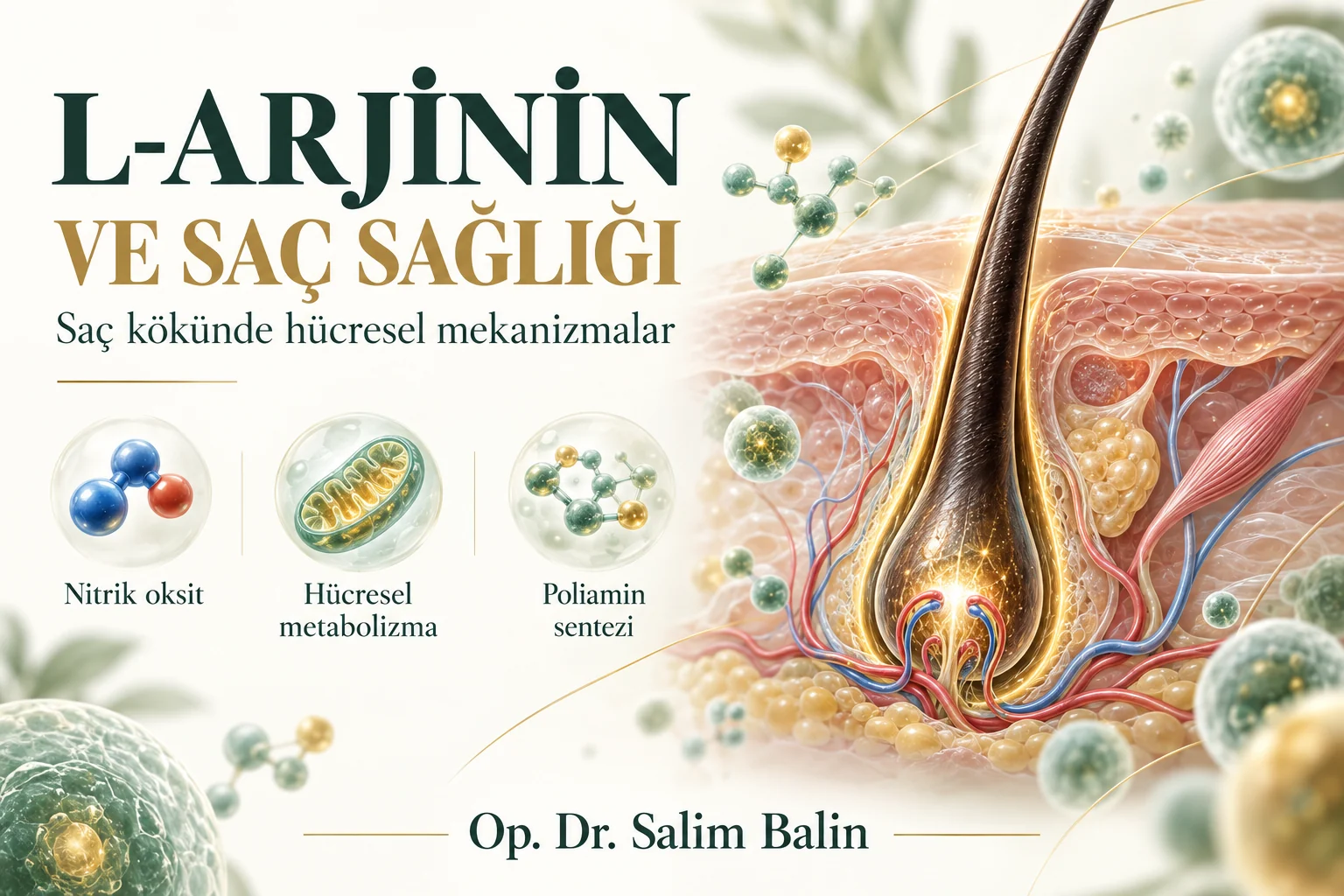
L-arginine is an amino acid involved in protein synthesis, nitric oxide production and polyamine metabolism in hair follicle cells. The uptake, production and consumption of arginine by cells in the hair root are regulated by transporter proteins and enzymes.
Studies in human hair follicle cultures, cell experiments and animal models have examined arginine metabolism in terms of hair growth, oxidative stress and cell proliferation.
How Does L-Arginine Enter Hair Follicle Cells?
The hair follicle contains different cell populations, such as the matrix cells that produce the hair shaft, outer root sheath cells and stem cells.
In the study by Duan and colleagues published in Advanced Science in 2025, the SLC7A1 transporter, which carries arginine into the cell, was detected particularly in follicle stem cells and outer root sheath cells. The ASS1 enzyme, involved in arginine synthesis, was found at high levels in the rapidly proliferating matrix cells.
The arginine-degrading enzyme ARG2 was shown in different cell groups of the follicle. In follicles taken from thinning areas of people with androgenetic alopecia, SLC7A1 levels were reduced, ARG2 levels were increased and the amount of arginine inside the follicle was lower.
Arginine, Oxidative Stress and Hair Growth
The matrix cells that produce the hair shaft proliferate rapidly throughout the growth phase. During this process, the cells’ amino acid requirements and growth signals are important.
In the 2025 study, arginine deficiency in cultured human hair follicles led to the accumulation of reactive oxygen species (ROS). This was accompanied by suppression of mTOR signalling, which is linked to cell growth and protein synthesis, reduced matrix cell proliferation and slower hair shaft elongation.
Restoring arginine reduced oxidative stress and supported mTOR signalling, cell proliferation and hair elongation. The growth response was also examined in human hair follicles treated with DHT.
L-Arginine and Nitric Oxide Production
L-arginine is a substrate used by the enzyme nitric oxide synthase (NOS). This reaction produces nitric oxide and L-citrulline:
L-arginine → NOS enzyme → Nitric oxide + L-citrulline
In a study published in 2026, L-arginine was applied to the skin using a hyaluronic acid-based liposomal carrier system. Increased nitric oxide production was reported in cell experiments and in a mouse model of androgenetic alopecia.
The study also reported that:
- 5-alpha reductase activity and DHT production decreased.
- Inflammation-related TNF‑α and IL‑6 levels decreased.
- Androgen receptor expression decreased.
- VEGF, linked to blood vessel formation, and the proliferation marker Ki67 increased.
- Hair regrowth was supported in the mouse model.
Arginine, Ornithine and the Polyamine Pathway
Another branch of arginine metabolism is the formation of ornithine and polyamines. The process proceeds in this order:
L-arginine → Ornithine → Putrescine → Spermidine → Spermine
The conversion of ornithine to putrescine is carried out by the enzyme ornithine decarboxylase (ODC).
A 1999 study showed that ODC is abundant in the proliferating bulb cells of hair follicles in the growth phase. ODC expression decreased as the follicle moved from the growth phase into catagen, the regression phase.
Spermidine Research in Human Hair Follicles
In a human hair follicle culture study published in 2011, 0.1–1 µM spermidine was applied. Hair shaft elongation increased and anagen, the growth phase, was prolonged.
Spermidine also increased the expression of keratins K15 and K19, which are associated with epithelial stem cells. Inhibiting ODC, the enzyme involved in polyamine synthesis, reduced K15 expression within the follicle.
Effects of L-Arginine in Animal Models
In the 2025 study, L-arginine was given in drinking water to mice whose hair growth had been suppressed with DHT. This supported regrowth of the fur.
In another part of the study, arginine-loaded microneedle patches were used. In mice, entry into the growth phase and regrowth increased.
Human hair follicles taken from people with androgenetic alopecia and transplanted into mice were also examined. After arginine-loaded microneedle treatment, increases were reported in hair shaft length, diameter and measures related to matrix cell proliferation.
Clinical Studies in Humans
Topical Lotion Containing Arginine and Zinc
The double-blind, randomised, placebo-controlled study by Rossi and colleagues, published online in 2021 and in print in 2022, included 40 people with androgenetic alopecia or telogen effluvium.
Participants used a lotion containing arginine and zinc, or a placebo, for 23 weeks. In the active lotion group, shedding assessed by the pull test decreased, the proportion of anagen hairs increased and the proportion of telogen hairs decreased. Phototrichogram assessments in twenty participants also showed results in favour of the active lotion group.
Oral Supplement Study Containing Arginine
The 2023 study by Starace and colleagues enrolled 20 people with telogen effluvium; 18 were evaluated. Participants took a supplement containing arginine, L-cystine, zinc and vitamin B6 for three months.
In this study, which had no placebo group, improvements in hair quantity and hair diameter were reported on clinical assessment and trichoscopy after three months.
L-arginine products in Türkiye and assessment in Ataşehir, Istanbul
When choosing hair lotions, shampoos or supplements containing L-arginine in Türkiye, check in what form and amount they contain arginine, whether they are applied to the scalp or taken by mouth, and whether product-specific clinical data exist.
At our clinic in Ataşehir, Istanbul, hair loss concerns are assessed individually, and options such as hair treatments, hair PRP and hair mesotherapy are planned accordingly. For delivering actives to the hair root, see also dissolving microneedles. Our personal care products for home use are available at drbalin.com.tr.
The clinic is in Atatürk Mahallesi, Ataşehir, in Metropol İstanbul Block B. Besides the Barbaros, İçerenköy, Küçükbakkalköy, Kayışdağı, Yenisahra and Ferhatpaşa neighbourhoods of Ataşehir, we see patients from Kadıköy (Kozyatağı, Bostancı, Göztepe, Erenköy), Ümraniye, Maltepe, Çekmeköy, Sancaktepe, Üsküdar, Kartal and other districts of Istanbul.
Frequently asked questions about L-arginine and hair health
What is L-arginine and how is it related to hair?
L-arginine is an amino acid involved in protein synthesis, nitric oxide production and polyamine metabolism in hair follicle cells. The uptake, production and consumption of arginine by cells in the hair root are regulated by transporter proteins and enzymes.
Is L-arginine good for hair loss?
Cell, human hair follicle culture and animal studies have linked arginine metabolism to hair growth. In humans there are only a few small studies: positive results were reported in a 40-person placebo-controlled study of a lotion containing arginine and zinc, and in a 20-person supplement study without a placebo group. Because these products contain other ingredients besides arginine, the results cannot be attributed to arginine alone.
Why is arginine reduced in the hair root in androgenetic alopecia?
In a 2025 study, follicles from thinning areas of people with androgenetic alopecia showed lower levels of SLC7A1, which carries arginine into cells, higher levels of ARG2, which breaks arginine down, and a lower amount of arginine inside the follicle.
How are L-arginine, nitric oxide and hair connected?
L-arginine is the substrate the NOS enzyme uses to produce nitric oxide and L-citrulline. In a 2026 study, L-arginine applied to the skin with hyaluronic acid-based liposomes increased nitric oxide production in cell and mouse models and supported hair regrowth in the mouse model.
What is spermidine and how is it related to arginine?
Spermidine is a polyamine formed from arginine via ornithine and putrescine. In a 2011 human hair follicle culture study, spermidine increased hair shaft elongation and prolonged the growth phase.
Should I use an L-arginine supplement or lotion?
Starting a product before the cause of hair loss is identified is not recommended. Iron deficiency, thyroid disease, telogen effluvium and androgenetic alopecia need different approaches. People who take regular medication, have a chronic illness, or are pregnant or breastfeeding should talk to a doctor before taking supplements.
Where can I have hair loss assessed in Istanbul?
Assessments take place at Op. Dr. Salim Balin's clinic at Atatürk Mahallesi, Ertuğrul Gazi Cad. No: 2H, Metropol İstanbul B Blok, Floor 18, No: 282, Ataşehir / Istanbul. For appointments, call or WhatsApp +90 506 520 30 55; opening hours are Monday–Saturday 09:00–18:00.
Related guides
Sources and further reading
Duan S et al. Arginine metabolic disruption impairs hair regeneration via ROS-mediated inactivation of mTOR signaling in androgenetic alopecia. Adv Sci. 2025 ↗Transdermal L-arginine and hyaluronic acid delivery to treat androgenetic alopecia through dual hormone modulation and anti-inflammatory action. Colloids Surf B Biointerfaces. 2026 ↗Nancarrow MJ et al. Dynamic expression of ornithine decarboxylase in hair growth. Mech Dev. 1999 ↗Ramot Y et al. Spermidine promotes human hair growth and is a novel modulator of human epithelial stem cell functions. PLoS One. 2011 ↗Rossi A et al. A new combination of molecules for the treatment of androgenetic alopecia and telogen effluvium: a double-blind randomized, monocentric, placebo-controlled study. Ital J Dermatol Venerol. 2021/2022 ↗Starace M et al. Clinical study on the efficacy and tolerability of an oral supplement based on arginine, L-cystine, zinc and B6 vitamin in patients with telogen effluvium. Ital J Dermatol Venerol. 2023;158:255–261 ↗This content is for information only and does not replace medical advice. Please consult your doctor about your symptoms. The cover image is illustrative.
Ask me
Get in touch with your questions about L-arginine, hair loss and hair treatments, or to request an appointment.
💬 Ask me on WhatsApp — +90 506 520 30 55
✉️ Ask me by email — info@drsalimbalin.com
📍 We are at Metropol İstanbul Mall, in the best location in Ataşehir, Istanbul.
Metropol İstanbul Block B, Floor 18 · Ataşehir/Istanbul · Directions ↗