Botox for anal fissure: when is it used, how does it work and what are the benefits?
Short answer: Botox for an anal fissure is mostly used for chronic fissures that have not healed despite stool softening and suitable creams; in selected patients it may be chosen earlier. Injected into the internal anal sphincter, Botox temporarily relaxes the muscle, reduces spasm and pressure, improves blood flow and creates the right conditions for the fissure to heal. Complete healing has been reported in about 50–80% of patients; the effect lasts about 3 months and the fissure can come back.
Op. Dr. Salim Balin performs Botox for anal fissure at his practice in Ataşehir, Istanbul, in suitable patients after examination.
Why does an anal fissure not heal? The pain–spasm–non-healing cycle
In an anal fissure, pain causes involuntary contraction of the internal anal sphincter. This contraction reduces blood flow to the area and makes it harder for the fissure to heal, creating a pain–spasm–non-healing cycle.
If this cycle is not broken, the fissure can last for weeks and become chronic. Fissures lasting longer than about 6–8 weeks, with hardened edges or a skin tag (sentinel pile), are usually considered chronic. For symptoms and other treatment options, see our anal fissure page.

When is Botox used for anal fissure?
Botox may be considered especially for chronic fissures that have not healed despite stool softening and suitable creams. In selected patients it may be chosen earlier; the decision is based on the examination.
The 2023 guideline of the American Society of Colon and Rectal Surgeons (ASCRS) recommends botulinum toxin for chronic anal fissure both as a second-line option when creams have not worked and as a first-line option in selected patients.
- Chronic fissure that has not healed with creams: the most common situation.
- People who want to avoid cutting the muscle: because its effect is temporary, it may be chosen before a permanent sphincterotomy.
- People at risk of continence problems: such as those with previous anal surgery or muscle weakness after childbirth, as an option that does not permanently cut the muscle.
The examination assesses the location and appearance of the fissure. Fissures in an unusual position, multiple fissures or those that will not heal are investigated for other causes.
How does Botox work in anal fissure?
Botox injected into the internal anal sphincter temporarily blocks the nerve signals that make the muscle contract, so the muscle relaxes. Pressure and spasm decrease, blood flow improves and the fissure has the right conditions to close. In short, the main benefit of Botox is releasing the spasm that prevents healing.
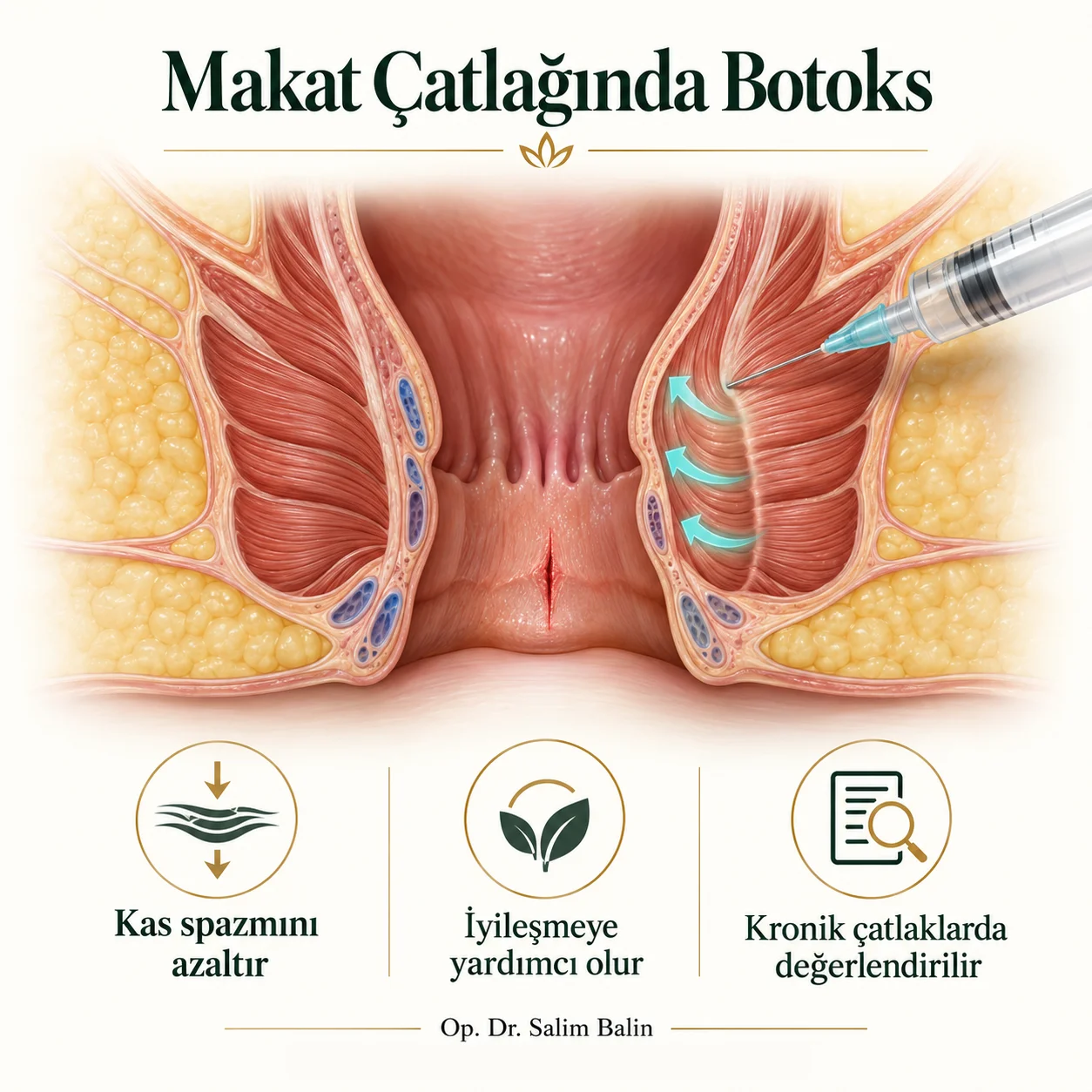
It is done as an outpatient procedure at the practice, usually takes a few minutes and needs no hospital stay. For the steps, dose and procedures that can be combined in the same session, see our Botox (botulinum toxin) for anal fissure guide.
What are the benefits and success rates of Botox?
Complete healing can be achieved in about 50–80% of patients. The main benefit of Botox is temporarily releasing the spasm that prevents healing without permanently cutting the muscle.
| Treatment | Published healing rates | Points to note |
|---|---|---|
| Creams (nitroglycerin, diltiazem, nifedipine) | Varies between studies; about 70% in the guideline | Side effects such as headache; regular use needed |
| Botox (botulinum toxin) | About 50–80%; on average around 67% in the guideline’s review | Effect is temporary; the fissure can come back |
| Lateral internal sphincterotomy (surgery) | 88–100% in studies | Permanent muscle cut; risk of gas/stool leakage in some patients |
Rates come from published studies and vary from person to person; they are not a promise of individual results. If Botox does not work, a repeat injection or surgical options are considered.

How long does Botox last, and can the fissure come back?
The effect lasts about three months; the aim is for the fissure to heal during this time. However, it does not work for everyone and the fissure can come back.
The effect starts within a few days, and the greatest pain relief is usually felt at around 3–4 weeks. Muscle strength gradually returns to normal. If the fissure recurs, Botox can be repeated in suitable patients or surgical options can be discussed.
What are the side effects of Botox for anal fissure?
- Temporary leakage of gas or stool: can occur in some patients and improves as muscle strength returns.
- Pain, slight bleeding or bruising at the injection site: usually short-lived.
- Rarely: local problems such as infection or haematoma.
Contact your doctor if you develop fever, increasing pain, swelling or bleeding that does not stop.
What helps the treatment succeed?
Controlling constipation and keeping stools soft are also needed for the treatment to work.
- A high-fibre diet and enough water; fibre supplements if your doctor recommends them
- Warm sitz baths
- Not sitting on the toilet for long and not straining
- Using recommended creams and attending follow-up appointments
For people who have trouble with straining or muscle tightening during bowel movements, biofeedback may help.
Frequently asked questions
When is Botox used for anal fissure?
Botox is mostly used for chronic anal fissures that have not healed despite stool softening and suitable creams. In selected patients it may be chosen earlier; the decision is based on the examination.
How does Botox heal an anal fissure?
Botox injected into the internal anal sphincter temporarily blocks the nerve signals to the muscle and relaxes it. Pressure and spasm decrease, blood flow improves and the fissure has the right conditions to close.
What is the success rate of Botox for anal fissure?
According to published data, complete healing can be achieved in about 50–80% of patients. Results vary; if Botox does not work, a repeat injection or surgery is considered.
How long does Botox last?
The effect lasts about three months. The aim is for the fissure to heal during this time; muscle strength gradually returns to normal.
What are the side effects of anal Botox?
The most important side effect is temporary leakage of gas or stool in some patients. Short-lived pain, slight bleeding or bruising at the injection site can also occur.
Can the fissure come back after Botox?
Yes. Controlling constipation and keeping stools soft reduce the risk; recurrent fissures can be treated with repeat Botox or surgery.
Where is Botox for anal fissure available in Ataşehir, Istanbul?
Op. Dr. Salim Balin performs Botox for anal fissure in suitable patients after examination at his practice at Metropol İstanbul, Block B, 18th floor, Ataşehir. For appointments call +90 506 520 30 55; fees are given after the examination.
Related guides
Botox for anal fissure: breaking the cycle of pain and muscle spasm ↗
Botox (botulinum toxin) for anal fissure – detailed guide ↗
Anal fissure: symptoms and treatment options ↗
Sources and further reading
Davids JS. et al. ASCRS Clinical Practice Guidelines for the Management of Anal Fissures. Dis Colon Rectum, 2023 ↗American Society of Colon and Rectal Surgeons (ASCRS) · Anal fissure: expanded patient information ↗Michigan Medicine · Anal Botox® injections: patient information (2025) ↗Updated: 23 October 2026 · Rates come from published sources and are not a promise of individual results. General patient information; a personal treatment plan is made after examination.
Ask me
Get in touch with your questions about this topic or to request an appointment.
💬 Ask me on WhatsApp — +90 506 520 30 55
✉️ Ask me by email — info@drsalimbalin.com
📍 We are at Metropol İstanbul Mall, in the best location in Ataşehir, Istanbul.
Metropol İstanbul Block B, Floor 18 · Ataşehir/Istanbul · Directions ↗