Laser Cellulite Treatment: Who Is It For and What to Expect?
Laser cellulite treatment is a minimally invasive procedure in which a 1470 nm endolaser is delivered under the skin through thin fibre-optic tips via small entry points, usually under local anaesthesia. The aim is to reduce dimpling and waviness and to improve accompanying skin laxity. Suitability is decided at examination by assessing the cellulite grade, skin laxity and localised fat separately.
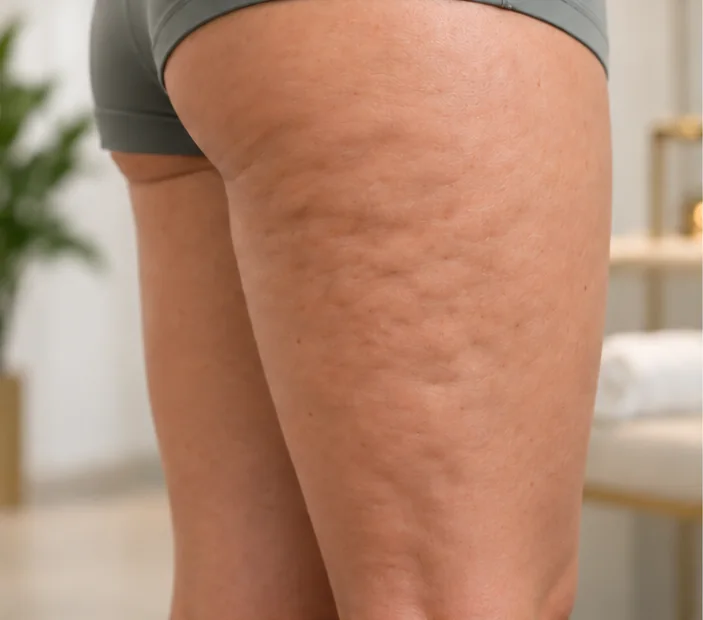
Cellulite shows itself as an orange-peel appearance of the skin, especially on the legs, buttocks and hips. It is not limited to people with excess weight; it can also appear in slim people who eat a balanced diet and exercise regularly. Skin structure, hormonal effects, genetics and the connective-tissue bands beneath the skin all play a role.
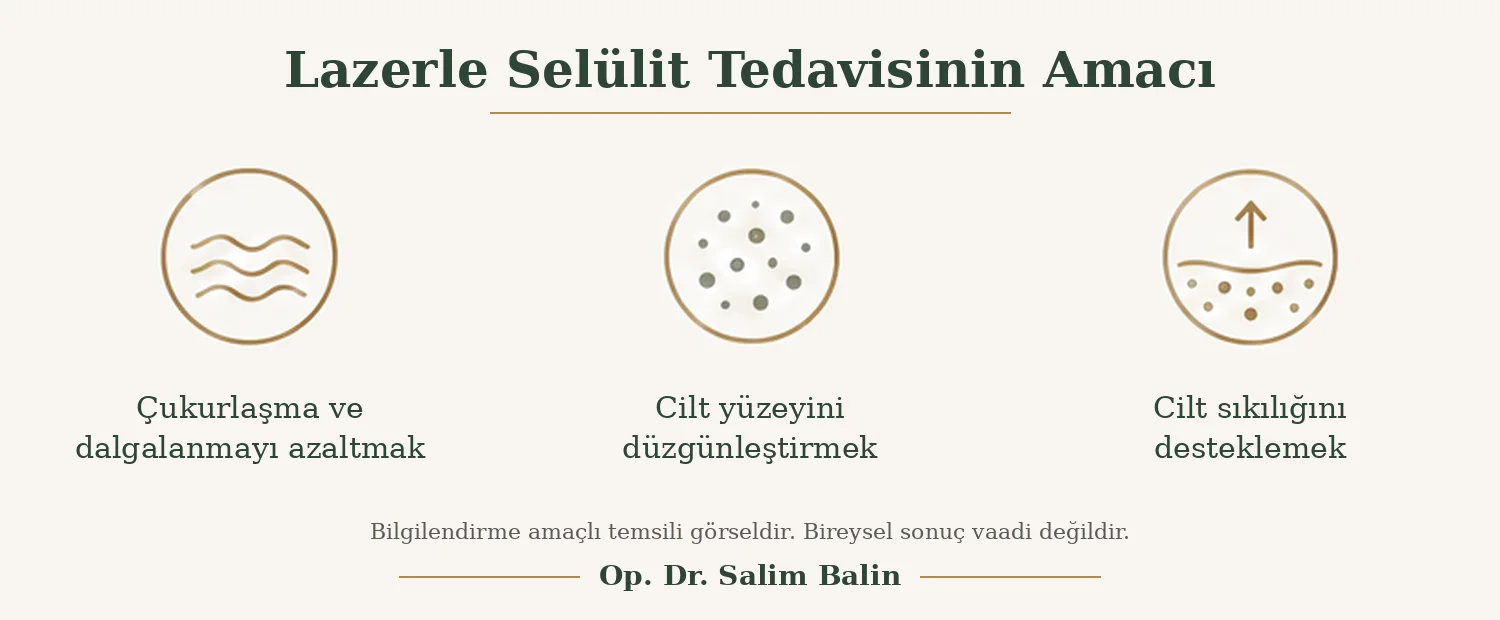
The aim of laser cellulite treatment is to reduce dimpling and waviness on the skin surface and to improve accompanying skin laxity. The scope of treatment is set according to the type of cellulite and the person’s needs.

How Is Cellulite Classified?
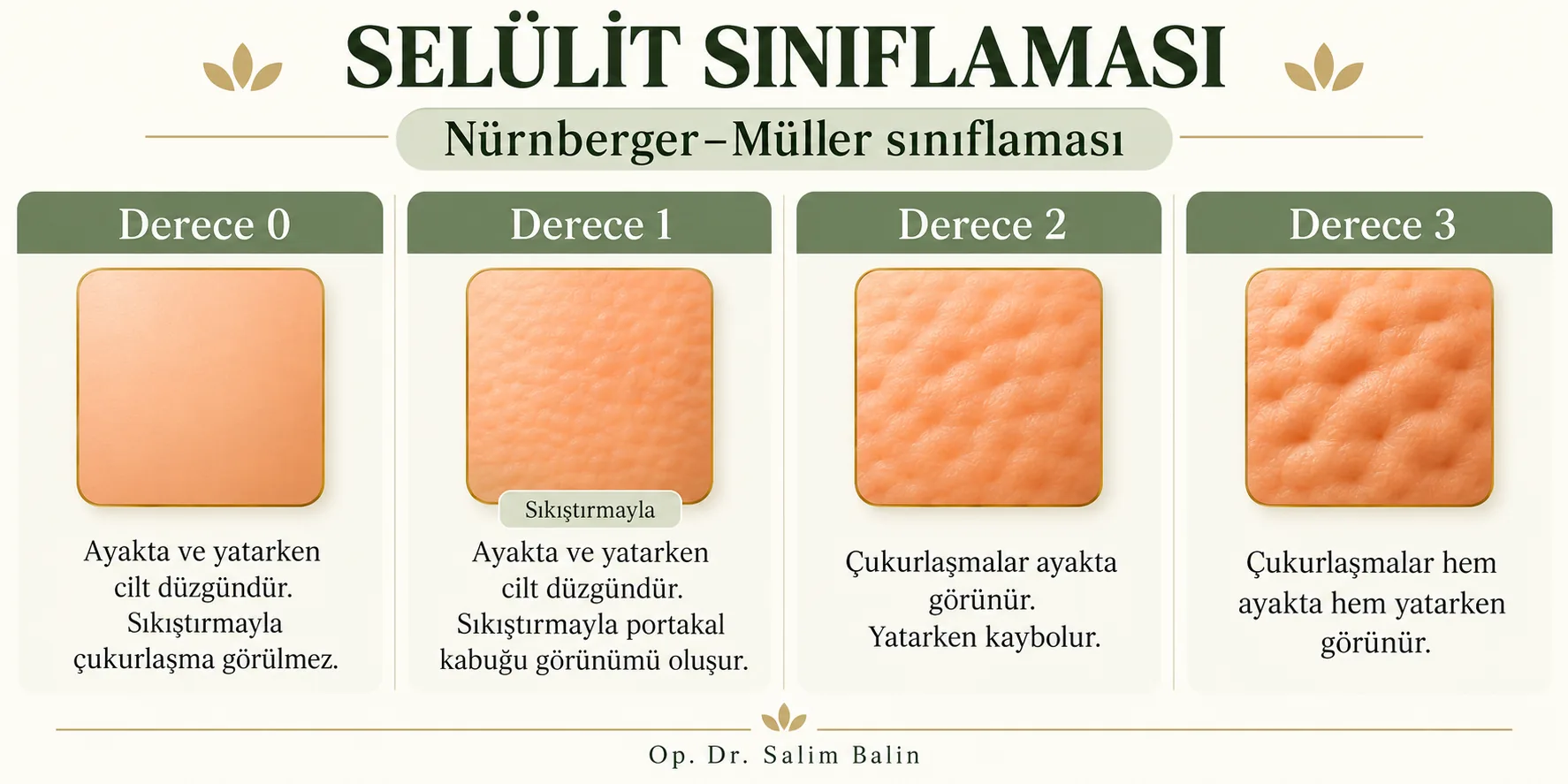
One of the most widely used ways to grade cellulite is the classification proposed by Nürnberger and Müller in 1978. It is based on how the skin looks when standing, lying down and when pinched:
- Grade 0: the skin is smooth standing and lying down; no dimpling when pinched.
- Grade 1: the skin is smooth standing and lying down; pinching produces an orange-peel appearance.
- Grade 2: dimpling is visible when standing and disappears when lying down.
- Grade 3: dimpling is visible both standing and lying down.
Assessed together with skin laxity, localised fat and the connective-tissue bands, the grade helps decide which method, or combination of methods, may be appropriate.
How Is Endolaser Cellulite Treatment Performed?
Endolaser is a minimally invasive laser procedure in which thin fibre-optic tips reach under the skin through small entry points. It is usually performed under local anaesthesia.
In systems working at a 1470 nm wavelength, laser energy is delivered to the tissues under the skin in a controlled way. Depending on the tissue level treated and the technique used, the goal is tissue contraction and, over time, collagen remodelling. This can improve skin firmness and surface appearance.
Although it does not require an open surgical incision, endolaser is a medical procedure performed under the skin. Proper patient selection, correct technique and follow-up are important.
Who Is Laser Cellulite Treatment Suitable For?
Laser treatment may be considered especially when cellulite is accompanied by mild to moderate skin laxity. People with waviness on the legs, buttocks or under the buttocks, and whose cellulite persists despite a stable weight, may be candidates.
It may also be considered for people whose skin firmness has decreased after weight loss. However, not all cellulite has the same structure, and not all cellulite responds the same way to the same treatment.
Deep, pronounced dimples may need additional procedures targeting the connective-tissue bands that pull the skin down. In people with advanced skin sagging, laser alone may not be enough. Cellulite, localised fat and skin laxity should therefore be assessed separately before treatment.
When Should the Procedure Be Postponed or Planned Carefully?
Aesthetic procedures are postponed during pregnancy and when there is active infection or an open wound in the treatment area. During breastfeeding, the timing and the medicines to be used are assessed by the doctor.
Treatment should be individually planned for people with bleeding disorders, blood-thinner use, conditions that affect wound healing or significant circulation problems. Varicose veins or autoimmune disease are also considered together with their type, severity and the treatment area.
At examination, existing conditions, current medicines and any previous procedures in the same area should be shared.
What to Expect During and After the Procedure?
The duration depends on the size of the treatment area and the scope of treatment. A brief needle prick may be felt during local anaesthesia. Pressure, pulling or mild discomfort may occur during the procedure.
Afterwards, swelling, tenderness, bruising and slight oozing from the small entry points may occur. These may take from a few days to a few weeks to settle. The return to daily life depends on the scope of the procedure and the individual healing process.
We recommend that all patients who have endolaser on the legs wear medium-compression stockings for 4–6 weeks for a better result. Post-procedure advice on exercise, massage and local care should also be followed. For details, see our article on recovery and care after endolaser.
Laser procedures can lead to complications such as burns, infection, pigment changes, temporary or permanent sensory changes and surface irregularities. Correct technique and appropriate follow-up are important in reducing these risks.
When Do Results Become Visible?
Some tightening may be noticed early on. However, because the early appearance can be affected by swelling, it is not right to judge the result straight away.
Collagen remodelling takes time. Change may become visible over weeks and continue for several months. Results are usually assessed over a 3–6 month period. This may vary with the method used and the individual tissue response. We also cover this in when do endolaser results show?
Is One Session Enough?
In laser cellulite treatment, one session is usually enough. However, some people may need several sessions depending on the cellulite grade, skin structure and response to treatment.
Are the Effects of Laser Cellulite Treatment Permanent?
How long the improvement lasts depends on skin structure, weight changes, ageing and the method used. Keeping weight stable and regular physical activity can help maintain body contour.
However, clinical data on the long-term results of 1470 nm endolaser for cellulite are limited. It is not right to give a definite duration that applies to everyone, or to say that cellulite will disappear completely.
The realistic goal of laser cellulite treatment is smoother, firmer-looking skin. To choose the appropriate method, the type of cellulite, skin quality and the person’s expectations should be assessed together at examination.
Laser cellulite treatment assessment in Ataşehir, Istanbul
At our clinic in Ataşehir, Istanbul, the cellulite grade, skin laxity and localised fat are assessed separately before laser cellulite treatment; we see patients from across Istanbul, including Kadıköy, Ümraniye, Maltepe, Çekmeköy and Üsküdar. For more detail, see our laser cellulite treatment and cellulite treatments pages, and our endolaser page for the method in general.
Our clinic is at Atatürk Mahallesi, Ertuğrul Gazi Cad. No: 2H, Metropol İstanbul B Blok, Floor 18, No: 282, 34750 Ataşehir/Istanbul. Address and directions
The clinic is in Atatürk Mahallesi, Ataşehir (Metropol İstanbul Block B), close to the Barbaros, İçerenköy, Küçükbakkalköy, Kayışdağı, Yenisahra and Ferhatpaşa neighbourhoods and to Kozyatağı, Bostancı, Göztepe and Erenköy in Kadıköy. Patients from Sancaktepe and Kartal are also welcome.
Frequently asked questions about laser cellulite treatment
How is laser cellulite treatment performed?
Endolaser is a minimally invasive laser procedure, usually under local anaesthesia, in which thin fibre-optic tips reach under the skin through small entry points. Laser energy at 1470 nm is delivered to the tissues in a controlled way, aiming for tissue contraction and collagen remodelling over time.
Who is laser cellulite treatment suitable for?
It may be considered especially when cellulite is accompanied by mild to moderate skin laxity, in people with waviness on the legs, buttocks or under the buttocks whose cellulite persists despite a stable weight. Deep dimples may need additional procedures; with advanced sagging, laser alone may not be enough.
What are the grades of cellulite?
In the Nürnberger–Müller classification, grade 0 skin is smooth standing, lying down and when pinched; grade 1 shows an orange-peel appearance only when pinched; grade 2 dimpling is visible standing and disappears lying down; grade 3 dimpling is visible both standing and lying down.
When is the procedure postponed?
Aesthetic procedures are postponed in pregnancy and when there is active infection or an open wound in the area. Breastfeeding, bleeding disorders, blood thinners, conditions affecting wound healing, significant circulation problems, varicose veins or autoimmune disease call for individual planning.
What should I expect after the procedure?
Swelling, tenderness, bruising and slight oozing from the entry points may occur and can take from a few days to a few weeks to settle. Patients who have endolaser on the legs are advised to wear medium-compression stockings for 4–6 weeks.
When do results become visible?
Because early appearance can be affected by swelling, results are not judged straight away. Collagen remodelling takes time; results are usually assessed over a 3–6 month period.
Is one session enough?
In laser cellulite treatment one session is usually enough. However, some people may need several sessions depending on the cellulite grade, skin structure and response to treatment.
Are the effects permanent?
How long the improvement lasts depends on skin structure, weight changes, ageing and the method used. Long-term clinical data on 1470 nm endolaser for cellulite are limited, so a definite duration cannot be given. The realistic goal is smoother, firmer-looking skin.
Where is laser cellulite treatment assessed in Ataşehir, Istanbul?
Assessments take place at Op. Dr. Salim Balin’s clinic at Atatürk Mahallesi, Ertuğrul Gazi Cad. No: 2H, Metropol İstanbul B Blok, Floor 18, No: 282, Ataşehir/Istanbul.
Sources and further reading
Nürnberger F, Müller G. So-called cellulite: an invented disease. J Dermatol Surg Oncol. 1978;4(3):221–229 ↗Khan MH, Victor F, Rao B, Sadick NS. Treatment of cellulite: Part I. Pathophysiology. J Am Acad Dermatol. 2010;62(3):361–370 ↗DiBernardo BE, Sasaki GH, Katz BE et al. A multicenter study for cellulite treatment using a 1440-nm Nd:YAG wavelength laser with side-firing fiber. Aesthet Surg J. 2016;36(3):335–343 ↗This content is for information only and does not replace medical advice. It is not a promise of individual results. Please consult your doctor about your symptoms. Images are illustrative.
Ask me
Get in touch with your questions about laser cellulite treatment and endolaser, or to request an appointment.
💬 Ask me on WhatsApp — +90 506 520 30 55
✉️ Ask me by email — info@drsalimbalin.com
📍 We are at Metropol İstanbul Mall, in the best location in Ataşehir, Istanbul.
Metropol İstanbul Block B, Floor 18 · Ataşehir/Istanbul · Directions ↗